

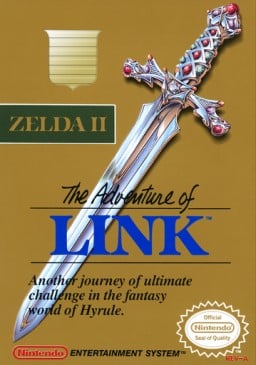
You beat the original Legend of Zelda. You know the rules — top-down grid, sword up, bomb the cracked wall, burn the suspicious bush. Then you pop Zelda II: The Adventure of Link into the NES and none of that muscle memory works. Link is walking sideways now. He’s got experience points. He’s fighting like it’s a completely different genre, because it basically is.
Zelda II first showed up in Japan on the Famicom Disk System on January 14, 1987 — less than a year after the original Legend of Zelda hit Japanese shelves, and seven months before that first game even reached North America. The NES version didn’t land stateside until December 1988, almost two full years after Japanese players had already moved on. When it finally arrived, it sold out fast enough that Nintendo Power named it Game of the Year for 1988. It went on to move 4.38 million copies worldwide, a genuinely huge number for a game so different from what fans expected.
That difference was on purpose. Shigeru Miyamoto wanted the sequel to feel nothing like its predecessor, so he handed it to a fresh team — directors Tadashi Sugiyama and Yasuhisa Yamamura, with Miyamoto producing and Takashi Tezuka writing the story. What they built was a strange hybrid: a top-down overworld map for walking between towns and dungeons, dropping into full side-scrolling combat the moment Link touched an enemy. No other Zelda game before or since has split the difference quite like that.
The RPG bones came from an unlikely place. Link’s experience points, which you pour into Attack, Magic, and Life to level him up, are a straight nod to Dragon Quest, which had come out in Japan the year before and was already reshaping how console games handled progression. The combat itself has a stranger pedigree — Link’s stand-and-crouch stance system, built to counter high and low enemy attacks, borrows directly from Kung-Fu Master, an arcade beat-em-up the same Nintendo team had ported to NES a few years earlier. Link’s swordplay, in other words, owes less to the original game’s dungeon crawling than it does to a martial-arts brawler.
None of that made Zelda II an easy sell to purists. Losing all your lives sent you back to the start of the entire game rather than the last save point, and the side-scrolling stages punished sloppy play far more than anything in the first game. It’s still the most argued-about entry in the series — some fans call it the black sheep, others call it underrated and ahead of its time. What’s harder to argue with is its influence: the leveling system, the magic spells, the towns full of NPCs handing out clues all became series staples, even after later games walked back the side-scrolling combat for good. We covered how the original Legend of Zelda changed the game with its battery save, and Zelda II is the awkward, ambitious middle child that came right after.
If you’re chasing a complete-in-box copy today, the artwork is part of the appeal — that gold-foil box with Link mid-swing is one of the more recognizable pieces of NES cover art out there, and box condition swings CIB value considerably given how many copies got tossed in a drawer without their sleeves. Whether you remember it as the one that broke the formula or the one that made the series richer, it’s worth knowing the whole strange story behind why Link suddenly knew how to fight like it was 1988 at the arcade.