

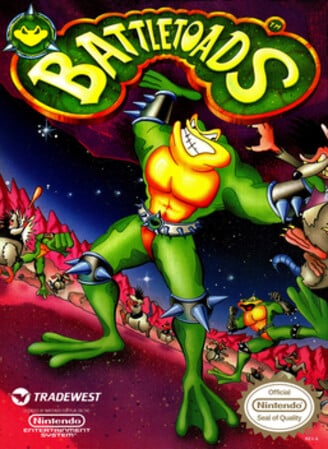
You rent Battletoads expecting Ninja Turtles with warts. The box has three snarling toads in leather and spikes, the title screen slaps, and the first level is a straightforward beat-’em-up brawl through a spaceship. Then level three hits. You’re on a hoverbike, the walls are closing in, and you die. Again. And again. Whatever weekend you had planned around finishing this rental just became a weekend spent memorizing one corridor.
Rare built Battletoads for the NES, and Tradewest published it in North America in June 1991. It moved more than a million copies at a moment when reptilian, wisecracking action heroes were basically their own genre — the Turtles had already proven there was an audience, and Rare wanted a piece of it with its own spin: mutant toads instead of turtles, and a genre-hopping structure that swapped fighting for racing, climbing, and platforming from stage to stage without warning.
That third level is the one everybody remembers. The Turbo Tunnel puts you on a speeder bike weaving through walls at a pace that punishes hesitation, with zero room for error and, for most of the game, zero passwords or saves to fall back on. Miss the timing once and you’re starting the whole level over. It’s still cited as one of the hardest stretches ever shipped on the console, and yet the game won seven 1991 Nintendo Power Awards, including Best Play Control and Best Multiplayer. Brutal and beloved turned out not to be a contradiction.
The game almost looked nothing like what shipped. Rare’s working title was “Amphibianz,” and early concept work leaned toward a Disney-flavored pitch before the team pushed it into meaner, punkier territory. Artist Kevin Bayliss sketched the toads with an eye toward merchandising — action figures, a coloring book, a Tiger handheld — the way he described it, “in a similar vein to Tim Burton’s Batman.” Tim Stamper airbrushed the final box art himself after the studio passed on Bayliss’s first attempt. A Battletoads cartoon pilot even got produced in 1992. It never found a network and quietly disappeared.
As for why the difficulty spikes so hard and so often, Rare’s own account is refreshingly unglamorous. Designer Gregg Mayles has said the studio looked at what was popular and “put its own spin on it,” and part of that spin, by most accounts, was making the game punishing enough to discourage a single-weekend rental from Blockbuster — a real commercial threat to publishers in 1991. Whether that was a deliberate business call or just a studio that got too close to its own playtesting to notice how hard it had gotten, nobody’s fully settled it. Either way, it’s a different theory of “hard” than the escalating, learnable difficulty of a game like Ninja Gaiden or Castlevania, where you’re climbing a ladder. Battletoads just kicks the ladder out from under you at level three and dares you to keep going.
For collectors, that rental era cuts both ways. A million-plus copies sold means Battletoads isn’t scarce the way something like Little Samson is. But a lot of those cartridges spent their working life bouncing between video store shelves and kids’ bedrooms, and boxes and manuals from that period rarely survived intact. A genuinely complete-in-box copy in sharp condition is a different animal from a loose cart, and it’s exactly the kind of distinction our grading process exists to sort out.
Whether you ever beat the Turbo Tunnel or just remember staring at it in disbelief, Battletoads earned its reputation honestly. Few NES games turned frustration into affection quite this well.