

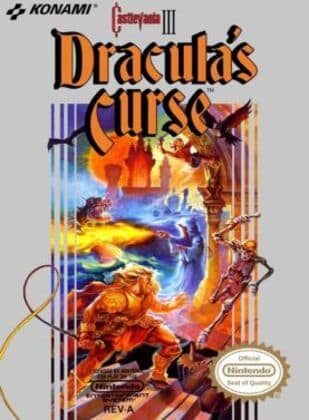
You rent Castlevania III from the video store on a Friday night, still sore from getting wrecked by Simon’s Quest a year earlier. The cartridge asks you a question almost immediately: which road do you want to take through the castle grounds? Pick one path and you might run into a swamp full of Medusa heads. Pick the other and you’re climbing a clock tower instead. Neither choice is wrong, and that’s the whole point. Konami had learned something from the confusing sequel that came before it, and Dracula’s Curse is the sound of a studio correcting course in exactly the right direction.
Konami released the game in Japan on December 22, 1989, as Akumajō Densetsu, and brought it to North America on September 19, 1990. The Japanese Famicom cartridge carried its own audio coprocessor, the VRC6, a chip that added extra sound channels the console didn’t normally have. American and European NES units had no such luxury, so composer Yoshinori Sasaki had to remix the entire soundtrack down to the standard five channels for the Western release. Play the Japanese and American versions back to back and the music genuinely sounds different, not just quieter.
The bigger change from the first two games was the cast. Trevor Belmont still carries the whip, but early in the adventure he can recruit one of three allies: Sypha Belnades, a sorceress with elemental spells, Grant Danasty, a pirate who can climb walls and ceilings, or Alucard, Dracula’s own son, who turns into a bat and lobs fireballs. Each companion changes how you play entire stages, and the game only lets you travel with one at a time, so a second playthrough with a different partner feels like a genuinely different game. Layer that on top of the branching stage selection and Castlevania III quietly became one of the most replayable games on the console, years before “multiple endings” was a marketing bullet point.
Western audiences also got a slightly softened game. Nintendo’s content policies at the time meant enemy nudity got covered up and some of the more overt religious iconography got toned down for the American release, standard practice for Konami titles crossing the Pacific in 1990. Grant’s attack even changed between versions, trading a thrown dagger for a stabbing motion. None of it dulled the difficulty, which stayed brutal by design.
The reception held up remarkably well over time. IGN later ranked it fifth on its list of the best NES games ever made, and GamesRadar placed it eighth. Iga himself, Koji Igarashi, the producer who would go on to shape Symphony of the Night, has called Dracula’s Curse a personal favorite and said more than once he’d like to remake it. That’s a rare compliment from someone whose job was reinventing the series for the next twenty years. If you want the full trilogy context, our original Castlevania spotlight covers where this all started, and Dracula’s Curse shows up again in our ranking of the best Konami games on NES.
Collectors treat it accordingly. A complete Castlevania III with box and manual isn’t as scarce as some of Konami’s earlier NES output, but graded copies in high condition still command real money, and cartridge label wear is common enough on this one that a sharp-eyed grader checks corners and seam glue before anything else. It’s a game worth having in your collection either way, whether you’re chasing a number on a slab or just replaying it with Sypha this time instead of Grant.
Full details on release dates and regional differences come from Wikipedia’s entry on Castlevania III: Dracula’s Curse.