

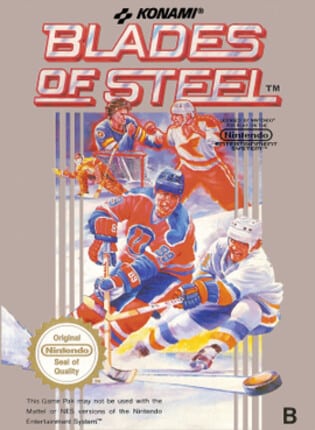
Ask anyone who owned an NES in 1988 what game turned polite living rooms into actual brawls, and there’s a good chance they say Blades of Steel. Konami’s hockey sim didn’t just let you score goals. It let you drop the gloves.
Konami had already proven the concept in arcades back in October 1987. The NES port landed in North America in December 1988, developed and published in-house by Konami, with programmer Shigeharu Umezaki leading the effort. It was fast for its era: three-on-three-plus-goalie action, digitized voice samples barking out plays, and the detail everyone remembers, a real fistfight system.
Collide with an opponent three times and the game stopped play for a one-on-one brawl, complete with a five-hit health bar. Win it, and your team skated back out on a power play. Lose enough of those fights in front of the other team’s net, and you’d rack up penalty shots taken soccer-style from the blue line. There’s no offside rule either, which sounds like an oversight until you realize it’s exactly why the games turn into track meets by the third period.
The box art has its own quiet history. That painted scene of two players tangling at center ice wasn’t invented from scratch. It’s based on a real photo from the 1983 Stanley Cup Finals, showing Wayne Gretzky and Tomas Jonsson. Konami’s artists swapped the uniforms, tweaked the likenesses, and dropped it onto cartridge boxes without ever naming names, since the NES version never carried an NHL license.
That license gap shows up in the game itself, too. Every team on the North American release goes by its city alone. No Bruins, no Rangers, just “Boston” and “New York.” Import the Japanese instruction manual, though, and the mask comes off. It lists nicknames like the Montreal Fighters, the Toronto Eagles, and the New York Devils, yes, that one slipped through. Konami clearly had rivalries in mind. They just weren’t allowed to print them here.
The Famicom Disk System version had actually come out five months earlier in Japan, and it’s a noticeably quieter game. No voice commentary, no fighting, no intermission animations. Whoever decided the NES port needed all three understood exactly what American kids wanted from a hockey game that wasn’t really simulating hockey so much as simulating a rink fight with occasional scoring.
It worked. Blades of Steel sold more than a million copies and stuck around long enough to get a Virtual Console re-release in 2007. It still holds up decades later; Nintendo Life gave it a 7 out of 10 in a modern re-review and called the gameplay “still as much fun as ever.” Curious how it stacks up against Konami’s other NES output? The Ranking the 10 Best Konami Games on the NES rundown is worth a look. Blades of Steel didn’t make that particular top ten, which says something about how deep Konami’s NES library actually ran.
On the grading side, Blades of Steel is a good reminder that common and cheap aren’t the same thing forever. A loose cartridge trades for around six dollars today. A genuinely sealed copy is a different animal, pulling in the neighborhood of $500 on recent sales. Not because the game is rare, but because almost nobody kept one factory-sealed through three decades of pickup games and cartridge-blowing. If you’re curious what separates a played copy from a graded one, our gallery of graded video games has real examples worth comparing.
Thirty-plus years later, Blades of Steel is still the answer when someone asks which NES sports game had the most personality. Turns out giving players a reason to throw punches was the smartest design decision Konami made all decade.