

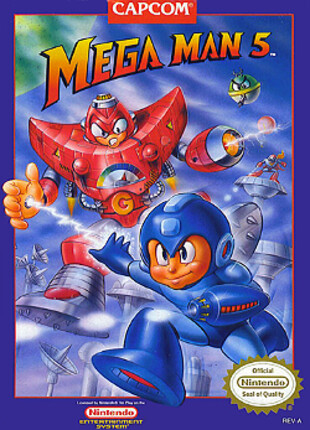
By December 1992, you knew exactly what you were getting into. Dr. Wily was behind it. Eight stages waited in whatever order you wanted to tackle them. The weapon-swap puzzle would click somewhere around the fourth boss, same as always. Mega Man 5 handed you something stranger to chase on top of all that: an actual pet.
Capcom had the series on a yearly schedule by this point, and it shows in how fast the plot gets moving. Proto Man appears to go rogue, leading an army of Robot Masters and kidnapping Dr. Light. That’s a real twist for a series that usually explains its plot in two sentences on the box. It isn’t really him, of course — Dr. Wily built a lookalike, one of four “Dark Man” robots, specifically to frame him. The genuine Proto Man shows up at the fortress to save the day, then disappears before anyone can properly thank him. He does this in nearly every game. Nobody ever learns.
All eight Robot Masters — Star Man, Gravity Man, Gyro Man, Stone Man, Crystal Man, Charge Man, Napalm Man, and Wave Man — came out of a design contest Capcom ran with Nintendo Power. More than 130,000 kids mailed in villain sketches. Artist Keiji Inafune had to redraw the winners several times before Capcom signed off, which is its own small miracle given the volume.
The real new idea, though, was Beat. He’s a small robotic bird, and he’s useless at first: you have to track down eight hidden letter plates scattered across the stages, one per level, before he’ll even show up. Find them all and he’ll dive-bomb enemies on command for the rest of the game, occasionally saving your skin against a boss you weren’t ready for. According to the North American manual, Dr. Light and Dr. Cossack were quietly building him together before Light’s kidnapping forced Cossack to finish the job alone. He also had a documented tendency to get distracted mid-flight and chase projectiles off the edge of the screen. Even the good robots had bugs.
Mechanically, Mega Man 5 is mostly a tune-up. The charged Mega Buster shot, introduced one game earlier, now covers a wider spread when you let it fly. Beyond that and a couple of gimmick stages — a vertical gravity-flip level, a submarine section — it plays close to the games before it. Reviewers noticed. GamePro gave it 4.5 out of 5 stars but still called it “déjà vu all over again,” joking that Capcom should get a rebate for recycling so much of the engine. A later 1UP retrospective was blunter, calling it “painfully phoned-in.” IGN’s retrospective review was kinder, landing at 8.5 out of 10 and naming it one of the easiest entries to pick up casually, criticism of the formula and all.
That reputation — solid but a little tired — tracks with what we see on the grading side. Mega Man 5 shows up regularly in submissions, usually in good shape, since it was a late-era NES release that didn’t get the same beating from years of rental-store circulation that the earlier games took. Complete-in-box copies with a clean, unfaded Beat illustration on the cover tend to grade well. It’s not the rarest cartridge in the library by a long shot, and it’s too late in the console’s life to ever carry a Black Box label — worth knowing if you’re chasing that specific era and not just the game itself.
If you’re working backward through the series, our Mega Man 4 spotlight covers the entry right before this one, fan-design contest and all. And if you’ve got a copy of any Mega Man game sitting in a closet, our gallery of graded cartridges is worth a look before you decide what it’s actually worth.
Five games in, Capcom hadn’t broken the formula. They’d just handed you a bird to catch while you waited for the next one.