

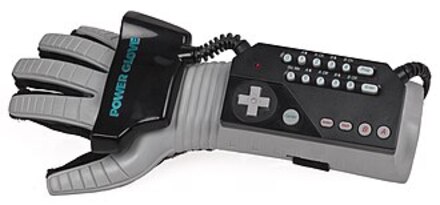
Every kid who saw The Wizard in theaters in December 1989 walked out wanting one thing, and it wasn’t a Nintendo Power Pad. It was the glove. Fred Savage’s little brother Lucas Barton strapped it on, flexed his fingers, and delivered the line that outlived the movie, the accessory, and most of the decade: “I love the Power Glove. It’s so bad.” Kids heard “bad” and took it as a compliment. Nintendo and Mattel were counting on exactly that.
The glove didn’t start as a toy. A researcher named Thomas Zimmerman built the original data glove concept, and Jaron Lanier’s company VPL Research turned it into a $8,800 piece of lab hardware used for early virtual reality experiments. Abrams/Gentile Entertainment licensed the idea and figured out how to build a consumer version for a fraction of that cost, replacing fiber optics with conductive ink printed on flexible plastic. Mattel manufactured and sold the result. The whole trip from NASA-grade hardware to a toy store shelf took a little over a year.
It launched for the 1989 holiday season at somewhere between $75 and $90, depending on the store, and retailers couldn’t get enough of them at first. Early orders ran into the hundreds of thousands after Nintendo showed it off at CES, and total sales eventually climbed toward a million units worldwide. Then people actually tried to play games with it.
Calibration meant clenching your fist at the screen before every session. The glove read finger position in four crude steps instead of anything resembling smooth motion, and only two games were built specifically around it: Super Glove Ball and Bad Street Brawler, neither one packed in the box. Reviewers and kids landed on the same verdict independently. Your arm gave out in fifteen minutes doing something a $6 D-pad handled instantly. Nintendo quietly let the accessory die within about a year of release.
What’s strange is how little that mattered to its reputation. The failure became the whole appeal. By the 2000s, hackers were tearing Power Gloves apart to build DIY motion controllers years before the Wii Remote or Kinect made that idea mainstream, and the device turned into one of gaming’s favorite punchlines-turned-cult-objects. A 2010s documentary even traced its afterlife as a hacker toy and meme machine. Few accessories manage to be a commercial dud and a beloved piece of NES folklore at the same time.
That afterlife shows up in what collectors pay today. A loose Power Glove is common enough and cheap, but a complete-in-box example with the original wrist strap, manual, and inner packaging intact is a different story, since most of these got torn open, used twice, and shoved in a closet rather than preserved. We see the same pattern across a lot of NES-era accessories: the box and the paperwork are what separate a $20 shelf piece from a genuine grading candidate, and that’s where a trained eye on sealed or complete lots actually earns its keep.
The glove never worked the way the commercials promised. Forty years later, that’s exactly why people still want one. You can read more about the movie that made it famous in our piece on The Wizard, and if you’re curious what a well-preserved piece of NES-era hardware looks like under a grader’s lens, our gallery of graded games is worth a look. For the deeper technical history, Wikipedia’s rundown on the glove’s development is solid.