

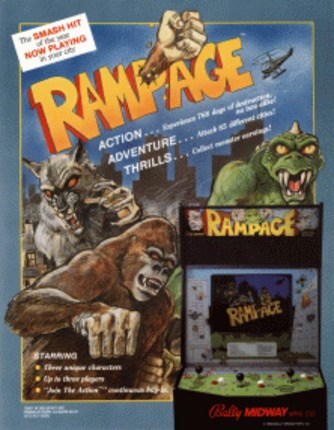
Bally Midway built an arcade game in 1986 with almost no rules. Lead designer Brian Colin wanted players free to just wreck things, with no set objective and no one telling them the “right” way to play. The result was Rampage: three humans turned into monsters by lab accidents, tearing apart American cities one building at a time. It worked. The first production run of 4,500 arcade cabinets sold out immediately, one of the last big hits Bally Midway ever had.
Data East brought Rampage home to the NES in December 1988, and the port made one decision that still annoys fans of the original. George the ape and Lizzie the lizard survived the trip. Ralph the werewolf did not. Two-player co-op still worked fine with just George and Lizzie, so the cut wasn’t a dealbreaker, but it left the cartridge’s box art and instruction manual describing a third monster nobody could actually pick.
What Data East added back partly made up for it. The NES version got a full soundtrack the coin-op never had, five tracks in all, along with hints scattered between cities and a map of the United States tracking how far you’d smashed your way across the country. Punching and eating share a single button, which turned out to be the right call. Reviewers at the time and decades later both called it intuitive, one of the few places the port improved on the original instead of just shrinking it. Everything else took a hit. The graphics lost detail and the sound got noticeably quieter. A generous 2009 retrospective review still called it clearly inferior to both the arcade version and the Sega Master System port that came out the same year.
None of that stopped Rampage’s monsters from outliving their own cartridge. Disney animators later confirmed that Wreck-It Ralph, the wrecking-ball star of their 2012 film, got his name as a direct nod to Rampage’s cut werewolf. Six years after that, Warner Bros. put Dwayne Johnson in an actual Rampage movie, swapping the transformed-human monsters for mutated animals but keeping George, Lizzie, and Ralph’s names intact. A werewolf too obscure for a 1988 NES cartridge ended up getting namechecked by two different Hollywood productions.
Rampage isn’t a cartridge collectors chase for rarity. Loose copies are easy to find and cheap by NES standards. What’s harder to find in good shape is the box, since it’s a licensed arcade port that plenty of kids rented rather than bought, and rental copies rarely came home with intact packaging. That’s the detail that actually moves a grade on something like this: not the game inside the cartridge, but whether the box art of George climbing that skyscraper survived four decades of shelves, basements, and yard sales. It’s the same story we cover in our gallery of graded games again and again, where condition tells you more than the game’s reputation ever will.
If a rough, cut-down arcade port sounds familiar, Paperboy went through nearly the same treatment landing on the NES a year earlier. Rampage never became the system-seller Data East probably hoped for, but the monsters found a second life anyway, one Hollywood check-in at a time, long after the cartridge itself stopped selling.