

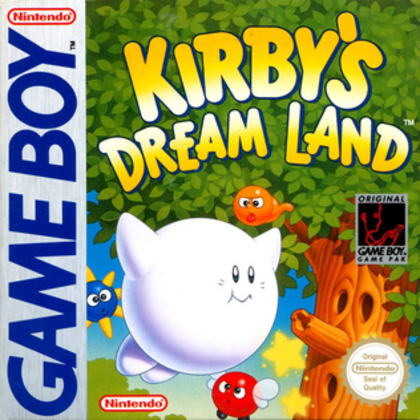
Two kids, one Game Boy, and a long car ride. That’s how most people actually experienced these games in 1989 and 1992 — passed hand to hand in the back seat, volume down low so it wouldn’t wake anyone up front. Whoever wasn’t holding it was watching over a shoulder, waiting their turn. The hardware itself was never the point. The games were. And few games say more about what Nintendo thought a handheld should be than Super Mario Land and Kirby’s Dream Land.
Super Mario Land shipped in North America in July 1989, just weeks after the Game Boy itself. It’s easy to forget it almost wasn’t the system’s headline launch title — Tetris took that job instead, once Nintendo decided a puzzle game would sell to more than just kids. Super Mario Land got built by Nintendo R&D1 under director Satoru Okada, with Gunpei Yokoi producing. Shigeru Miyamoto had nothing to do with it, and it shows. Princess Daisy debuts here instead of Peach. The setting is Sarasaland, not the Mushroom Kingdom. Two of the twelve levels turn into Gradius-style shooter stages, with Mario piloting a submarine or a tiny plane and firing off bouncing Superballs instead of fireballs. It’s a stranger game than its box art lets on, and a harder one — hit points are gone, so one wrong touch usually ends the run.
Kirby’s Dream Land arrived three years later as the opposite kind of experiment. It was Masahiro Sakurai’s first game as director, made at HAL Laboratory, and he built it around a specific frustration: action games were too hard for people who didn’t already play action games. So Kirby can float indefinitely. He inhales enemies and spits them back out. A first-time player can realistically finish the whole game in an afternoon. Sakurai didn’t ignore the players who wanted more, though — he buried a hard mode and adjustable lives and health behind the ending, so the challenge was there for anyone who went looking.
Both approaches worked, commercially and otherwise. Super Mario Land went on to sell somewhere north of 25 million copies worldwide, making it one of the best-selling games on the entire system. Kirby’s Dream Land sold more modestly out of the gate but kept selling for decades — it held the record as the franchise’s best-selling entry until Kirby and the Forgotten Land finally passed it in 2022. Both still land on any honest ranking of the system’s biggest sellers.
So which one actually mattered more? Super Mario Land proved Nintendo’s A-list characters could survive a total creative reshuffle and land on a screen the size of a business card, weird shooter levels and all. Kirby’s Dream Land proved something arguably bigger: that a game could be genuinely finishable by someone who’d never finished a video game before, and still hold enough underneath for the players who wanted a real challenge. One expanded what Mario could be. The other expanded who got to play in the first place. If you’re picking the more important debut, that second answer is hard to argue against.
Collectors chasing either one in top condition run into the same problem: early black-and-white Game Boy boxes were thin cardboard, prone to crushed corners and sun-faded artwork, so a tight, unfaded sealed copy of either title is scarcer than the print numbers alone would suggest. It’s the kind of detail that matters once a cartridge goes up for grading — seam integrity and box wear can be the difference between grade tiers. Our gallery of graded games has examples of both eras worth a look if you want to see what separates a solid copy from an exceptional one.