

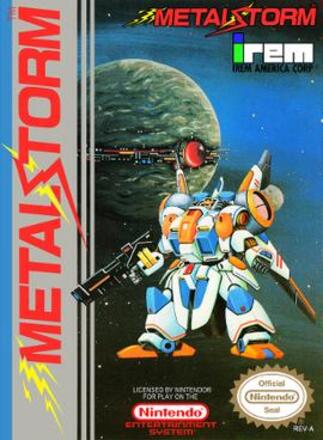
Picture flipping open the March 1991 issue of Nintendo Power. The cover is a mech standing upside down on a ceiling, guns blazing, with a twelve-page strategy guide waiting inside. That’s the full marketing weight of Nintendo’s own magazine thrown behind one cartridge. It still didn’t sell.
The cartridge was Metal Storm, built by Tamtex, a small Tokyo studio owned by Irem, around a single trick. Press up and jump together and your mech, the M-308 Gunner, instantly flips between floor and ceiling, and gravity flips right along with it. Every stage, every enemy pattern, every hazard gets designed around that one move. Six two-act levels, a boss rush at the end, and an Expert Mode that strips your power-ups and rearranges the whole game once you’ve already beaten it.
The trick wasn’t only clever level design. It was closer to a magic act for hardware that wasn’t supposed to pull it off. The NES can’t do true parallax scrolling on its own, but Metal Storm’s cartridge packed a custom memory-bank-switching chip that scrolled two background layers independently, something almost no other NES game managed. Readers who caught our look at the 10NES chip already know how tightly Nintendo controlled what a licensed cartridge was even allowed to contain. Irem found room inside that leash to build something nobody else bothered trying.
Overseas critics noticed immediately. Computer and Video Games gave it 88 out of 100 and called it “a slick, beautifully executed game with a novel twist.” Mean Machines landed at 88 percent. Electronic Gaming Monthly scored it 7.75 out of 10. Nintendo Power, the magazine that put the thing on its cover, gave the oddly modest number of 3.7 out of 5.
Then February 1991 happened to it. Irem released Metal Storm in North America at the exact moment the Super NES was landing on store shelves, and the entire industry’s attention went with it. Nintendo Power’s own 1993 “Unsung Heroes” retrospective later blamed thin distribution for burying a game its own writers liked. A short print run followed, which is just what happens to a cartridge nobody bothers reordering.
That short print run is why collectors care now. A clean, complete copy runs somewhere between $400 and $700 today, well above what a typical late-period NES action game commands. Sealed copies have sold for $1,100 to $2,400 depending on the listing, and graded sealed copies carrying a WATA or VGA number have cleared anywhere from $2,400 to nearly $4,000. None of that reflects how the game actually played in 1991. It reflects how few copies anyone bothered keeping.
Japan got the better version anyway, over a year later. The Famicom release, Jūryoku Sōkō Metal Storm, arrived in April 1992 with a full opening cinema, restored producer credits, and dialogue the American cartridge never had room for. It took until 2019 for English speakers to get an official shot at that cut, when Retro-Bit and Limited Run Games reissued it on cartridge with a small figurine of the Gunner mech tucked into the box. Call it the industry finally admitting, three decades on, that it shipped the rough draft the first time.
Metal Storm isn’t the only late-era NES cartridge that got buried by bad timing and a thin shelf life. We ran into the same story with Shatterhand, a game Jaleco quietly de-licensed from a Japanese tokusatsu show and sent out the door with almost no fanfare. Both are the kind of cartridge worth checking twice before you assume the common-looking box in a bargain bin is actually common. If you’re ever sizing up a copy for grading, the usual rules still apply: check the condition of that cardboard carefully before you trust a seller’s description, something our gallery of graded cartridges can give you a feel for firsthand. For the full rundown on the game itself, including its Japanese release, see the Wikipedia entry on Metal Storm.