

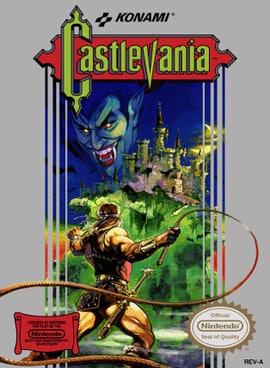
You rented it because the box looked like a horror movie poster. A guy in armor, a whip, a castle silhouette against a full moon. Then you got it home, hit start, and Konami’s music kicked in over eighteen stages that took a whip-wielding vampire hunter through a haunted castle stocked with Frankenstein’s monster, the Grim Reaper, and Dracula himself waiting in the final room. Nothing else on the NES in 1987 felt quite that theatrical.
Castlevania was developed and published by Konami, first appearing in Japan in September 1986 on the Famicom Disk System under the title Akumajō Dracula. The North American cartridge release followed in 1987, and Europe got its version in 1988. Konami of America’s Emil Heidkamp pushed for the name change, worried the original Japanese title’s religious overtones wouldn’t play well stateside. He wasn’t wrong to worry, but he also handed the series a name that’s outlasted every other decision made about it.
The game put you in control of Simon Belmont, working through six blocks of three stages apiece with a leather whip as your only real weapon until you found something better. Holy water, throwing axes, boomerang crosses, and a stopwatch that froze enemies in place all turned up as sub-weapons, each one changing how you approached a room. Jumping was stiff and committed you fully once you left the ground, and stairs killed momentum entirely. That rigidity is exactly what made the boss fights land: you couldn’t dodge your way out of a bad read, so you learned patterns instead.
Director Hitoshi Akamatsu wanted something that played like a horror film rather than a typical action game, and the credits reflect it. Early in development, Simon wasn’t even named Simon. Internal documents referred to him as Peter Dante, a nod to horror actor Peter Cushing and director Joe Dante, with his family line traced back to a Christopher Dante honoring Christopher Lee. Konami eventually renamed him Belmont, but the horror-movie DNA never left the game. The 1986 release also landed near the 90th anniversary of Bram Stoker’s original Dracula novel, whether intentionally timed or not.
Reviewers noticed. Famitsu rated it as the highest-scoring game the magazine reviewed that year, and Nintendo Power later placed it among the best NES titles ever made. IGN has ranked it in its top tier of NES releases more than once. None of that acclaim made it easy. The later stages punish careless jumps and force you to memorize enemy placement the hard way, and that difficulty is a big part of why the game still gets discussed instead of forgotten.
Konami followed it with sequels for decades, but the original still holds up as the cleanest version of the idea: a horror movie you controlled, built during the same stretch of NES history covered in our look at the Nintendo Seal of Quality, back when a gold sticker on the box was still doing a lot of the work of telling players a third-party game was worth the rental.
Complete-in-box copies from 1987 show up regularly, but condition varies wildly since it was such a heavily rented and traded title. A worn label or a cracked case knocks the value down fast, so if you’ve got one tucked away, it’s worth checking what actually separates a beat-up copy from a genuinely well-kept one before you price it. Our grading process breaks down what we look for.