

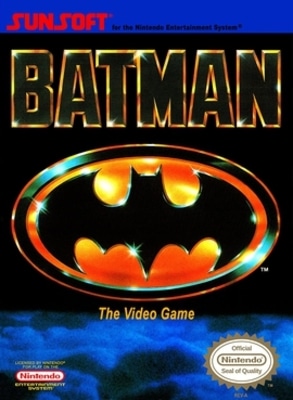
Every kid who grew up renting games from a video store learned the same lesson eventually: a box with a big movie license on it was almost always a warning sign. Movie tie-in games in the NES era ranged from rushed to unplayable, built on a deadline instead of an idea. Then Sunsoft put out Batman: The Video Game, and for once the license actually earned its place on the cartridge.
Sunsoft released the game in North America in February 1990, a few months after it hit Japan and about half a year before European players got their copy. It rode in on the wave of Tim Burton’s 1989 Batman film, one of the biggest movies of the year, and Sunsoft reportedly paid Warner Bros. roughly a million dollars just for the rights. That was a serious bet for a single cartridge. To make sure the game matched the film’s mood, Sunsoft’s development team traveled to London and walked Burton’s actual production sets before writing a line of code.
The gameplay backed up the investment. Batman could wall jump between surfaces, a move that barely existed in NES platformers at the time and gave the game a distinct rhythm compared to anything else on the shelf. Beyond his fists, he carried batarangs, batdisks, and batpoons powered by pellet cartridges, letting players pick a tool for the situation instead of mashing one button through five stages of Gotham City. The boss lineup read like a highlight reel: Killer Moth, a rogue Machine Intelligence System, the Electrocutioner, a Firebug-triggered gauntlet, and finally the Joker himself.
That final fight almost didn’t happen. In an earlier build of the game, Firebug was the last boss, and the Joker never showed up as a fight at all — his defeat played out in a cutscene instead. Someone at Sunsoft decided the game needed to end with Batman and the Joker trading blows directly, and that’s the version that shipped.
Critics noticed the extra effort. Scores across magazines ranged from the low 60s to the mid-90s depending on the outlet, and Electronic Gaming Monthly named it Best Movie-to-Game of 1989. Almost two decades later, IGN still ranked it #33 on its list of the top 100 NES games. Composer Naoki Kodaka’s soundtrack has aged into something of a cult favorite on its own, still turning up in chiptune remix circles today, long after most movie-game scores were forgotten along with the movies they were tied to.
Compare that to how rough most licensed NES games actually were. Konami’s Teenage Mutant Ninja Turtles punished players so badly its own co-creator couldn’t finish it. Sunsoft’s Batman went the other direction, building a game confident enough to stand on its own outside the theater.
None of this makes Batman a rare or especially valuable NES cart today — Sunsoft printed plenty of copies, and it shows up regularly in collections and at shows. What it does mean is there’s no shortage of complete, well-preserved boxes still floating around for anyone who wants to grade one, provided you know what to check on the box, manual, and cartridge label before you buy. That’s exactly the kind of thing we walk through on our how it works page.
Not every game built around a movie needed a script rewrite this late to find its ending. Somewhere in a Sunsoft office in 1989, someone looked at a finished game with Firebug as the final boss and decided Batman deserved to fight the Joker instead. They were right.