
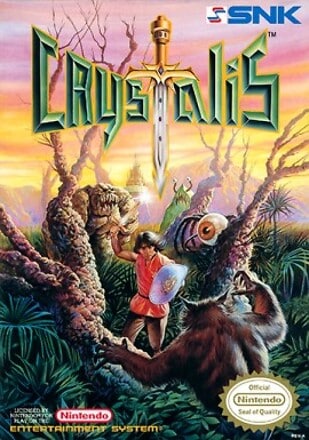
Pull an NES cartridge library out of a closet and Crystalis usually turns up somewhere in the middle, wedged between a Contra and a Double Dragon, half-forgotten. That’s a shame, because the box art alone earns a second look, and the premise underneath it is stranger than almost anything else on the console. SNK set the story in the year 2097, exactly one century after a thermonuclear war wipes out civilization in 1997. When the game shipped in July 1990, that war was still seven years in the future. Players weren’t looking back at an apocalypse. They were looking forward to one, in a game rated E for everyone.
Crystalis was developed and published by SNK, the same company that would go on to build the King of Fighters empire, and it hit Japan on April 13, 1990 before reaching North America a few months later. It’s an action role-playing game in the Zelda mold: top-down view, eight-directional movement, experience points that raise your health and attack power as you grind through monsters. What set it apart was the sword system. Your hero carries four elemental blades, Wind, Fire, Water, and Thunder, each one doubling as a combat tool and a puzzle key. The Fire sword melts ice bridges. The Water sword calms ocean currents so you can walk across them. Later you fuse all four into the Crystalis blade itself, and the game finally lets you breathe.
Critics liked what they saw. Electronic Gaming Monthly’s four reviewers split between 7s and 8s. They liked the graphics and the soundtrack, and they singled out a plot that was unusually ambitious for a 1990 action game. Some writers noted the visual and tonal debt to Hayao Miyazaki’s Nausicaä of the Valley of the Wind, which tracks. Years later, IGN ranked Crystalis 42nd on its list of the top 100 NES games, and Nintendo Power slotted it at 115 in a 2005 retrospective ranking. The complaints were consistent too: combat could get repetitive, and the collision detection was loose enough that mashing the attack button often worked better than actually aiming.
Here’s a trivia detail SNK fans love: two of the game’s sages, Kensu and Asina, are named after Sie Kensou and Athena Asamiya, characters from SNK’s earlier arcade game Psycho Soldier. Both of them went on to become regulars in King of Fighters. It’s a quiet thread connecting a quirky NES RPG to one of fighting game history’s longest-running rosters, years before anyone knew King of Fighters would exist.
Crystalis never got the shelf space or marketing muscle that Nintendo put behind The Legend of Zelda, the game it most invites comparison to, and that matters for collectors today. A third-party publisher with a smaller print run means clean, complete-in-box copies show up less often than the true first-party heavy hitters, and condition varies a lot more from one loose cartridge to the next. If you’ve got one sitting in a closet, it’s worth having it properly graded and documented rather than guessing at what you’ve got.
The fictional war came and went in 1997 without incident, obviously. What didn’t come and go is a genuinely inventive action-RPG that SNK built almost as a side project, outside the fighting games the company is best remembered for. It deserves better than the middle of the shelf.