

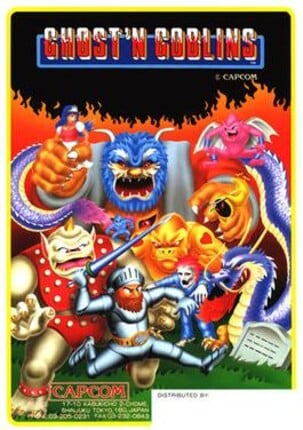
You’re eight levels deep into a cardboard-boxed NES cartridge, sword raised, feeling like a real knight for once. A flying red imp swoops in from off-screen and you’re dead. Two hits and you’re back at the graveyard where you started. That’s Ghosts ‘n Goblins, and it introduced an entire generation of American kids to a very specific kind of controller-throwing rage.
Capcom released the original arcade version on September 5, 1985, directed by Tokuro Fujiwara, a name worth remembering since he’d go on to shape Mega Man and Bionic Commando too. Sir Arthur, our knight in his underwear if you get hit twice in a row, chases the demon lord Astaroth across six stages to rescue Princess Prin-Prin. The setup is simple. The execution is brutal.
Arthur’s arsenal grows as you find new weapons scattered across each stage: a torch, a dagger, an axe, a spear, even a shield you can lob at enemies. The catch is that certain bosses only fall to certain weapons. Dragons shrug off the lance entirely, and figuring that out through trial and error, usually while dying repeatedly, is half the game’s design philosophy.
The Famicom port hit Japan on June 13, 1986, and mattered for a reason that had nothing to do with gameplay: it was the first Famicom cartridge built on a 128 KB chip, letting Capcom pack in more of the arcade’s punishment than most home ports of that era could manage. North America got its copy that November, coded by Micronics and published by Capcom.
People bought it anyway. The NES version sold 1.64 million units worldwide, and on European home computers it held the number one spot on the UK charts for two straight months in the summer of 1986, finishing as the country’s sixth best-selling game that year. Reviewers noticed the craftsmanship even while getting demolished by it. Computer Gaming World called the NES version proof of what the console could really do.
Here’s the detail that separates this game from merely “hard.” Beat the final boss, watch the ending, and you still aren’t done. The credits reveal that the weapon Astaroth handed you was cursed, and the game dumps you back at level one on a harder difficulty to fight the real final battle. Fujiwara built a career on this kind of cruelty, and decades later he was still at it, directing 2021’s Ghosts ‘n Goblins Resurrection with that same two-playthrough sting intact.
Not everyone thought the punishment was worth it. IGN’s later retrospective argued the difficulty made the game “a waste of time” for most players given what it cost at retail. Fair criticism. It didn’t matter much to Capcom’s bottom line. Ghosts ‘n Goblins, alongside the studio’s earlier hit Commando, helped push the company into 8-bit stardom, and the game still shows up on nearly every “hardest games ever made” list gaming journalists publish.
If you’re chasing a complete copy for a collection, watch the box before anything else. Capcom’s early cardboard packaging is fragile, prone to crushing and yellowing in a way that Nintendo’s later, sturdier NES boxes mostly avoided. A genuinely sharp complete-in-box copy is scarcer than the sales numbers alone would suggest, which is exactly the kind of condition detail our Mega Man 2 spotlight ran into as well. Worth a close look before you assume “good condition” means what you think it means.
Check out our grading breakdown if you want the full picture on what separates a shelf copy from a genuinely graded one, and read more about the original game’s history on Wikipedia.