

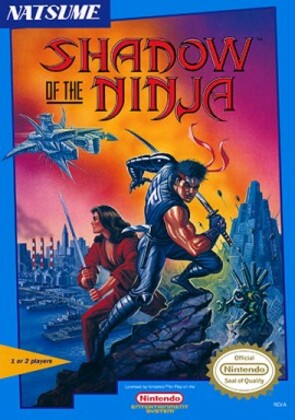
Somewhere in a flea-market bin, under three copies of Track & Field and a loose Duck Hunt cartridge, there’s a box with two ninjas on it. One purple, one orange. No movie tie-in, no cartoon, no household-name hero. Just “Shadow of the Ninja” in block letters and a cover that looks like it was ripped off a VHS rental sleeve. Most collectors walk past it. That’s a mistake.
Natsume released Shadow of the Ninja in North America in December 1990, and the studio did something unusual for a company its size: it developed the game and published it itself, no Nintendo-adjacent publishing partner smoothing the way. The setup is simple. Two Iga-clan ninja, Hayate and Kaede, infiltrate a fortress in a near-future New York to take down a dictator named Garuda. Either character plays identically, and the game supports full two-player co-op, which was still not a given on the NES in 1990.
The combat holds up better than you’d expect from a licensed-nothing platformer nobody outside retro circles talks about. You start with a katana, swap it for a kusarigama chain weapon, and can stack duplicate pickups to upgrade either one up to three levels (take a hit, and that level drops right back down). Burn more than half your vitality and you can unleash a screen-clearing thunderstorm attack that wipes every visible enemy — a real risk-reward mechanic buried in a game most sites file under “also ran.”
The press noticed at the time, even if the public didn’t. GamePro gave it a 23 out of 25 in a 1991 “Greatest Hits” roundup. Electronic Gaming Monthly called the graphics and sound “superb.” The British magazine Total! gave it 74 percent and flat-out called it the best NES cartridge of its kind. Nintendo Power’s “Weird Heroes” feature that same year pointed out something easy to miss: Hayate and Kaede were among the first male-and-female duos presented as genuine equals in a video game, no rescue-the-princess framing involved.
Here’s the part that actually makes this one worth telling. Natsume built a Game Boy version of Shadow of the Ninja too. It never came out under that name. Tecmo bought the publishing rights, slapped its own flagship ninja’s name on the box, and released it in 1991 as Ninja Gaiden Shadow — a spin-off of a franchise it had nothing to do with, wearing someone else’s game like a costume. Tecmo was busy with its own numbered Ninja Gaiden sequels on the NES around the same time; this one just got folded into the family by acquisition instead of development.
There’s a grading footnote here too. In 1991, GamePro ran a contest giving ten readers an exclusive copy of the game with a password-save feature that no retail cartridge ever shipped with. Ten copies, a feature that doesn’t exist anywhere else, no public record of one ever surfacing in a graded collection. If one turns up someday, it’s the kind of submission that would make a grader’s week.
The game got a proper second life in 2024 with Shadow of the Ninja: Reborn, a from-scratch remake that landed on Switch, PlayStation, Xbox, and PC. That’s a nice vote of confidence from people who didn’t have to care. The original NES cartridge, meanwhile, just sits there in bins, waiting for someone to notice the two ninjas on the cover were worth a second look thirty-five years ago.