

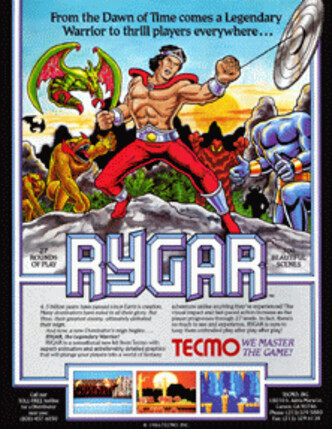
Picture a kid in 1987, renting a cartridge off the strength of a cool-looking disc weapon on the box, expecting a quick arcade-style romp. Instead they got a sprawling top-down world, a leveling system, and a quest that took actual hours to finish, on a cartridge with no save feature and no password screen. That kid either finished Rygar in one punishing sitting or never saw the ending at all.
The arcade original, released by Tecmo in 1986, was barely a game with a story. You walked right and swung a bladed yo-yo called the Diskarmor. Eventually you reached a boss named Ligar. That’s the whole plot. When Tecmo ported it to the NES the following year, something strange happened: the development team decided the home version deserved an actual world.
They built Argool, a paradise corrupted by the demon Ligar, and resurrected a dead warrior to set it right. They added a hub area shown from a top-down view, with new paths opening up as you found a grappling hook, a crossbow, and other gear, gating progress through exploration instead of just tougher enemies. They threw in experience points, two separate stat tracks (Tone for attack, Lasting for health), and a magic system that spent Mind Points dropped by dead enemies. None of that existed in the arcade cabinet. All of it got bolted onto a Tecmo coin-op nobody was clamoring for a sequel to.
It worked. Computer Entertainer called it some of the best visual work on the console at the time. Tilt magazine praised the adaptation and only knocked it for the missing save system. AllGame later gave it 4.5 out of 5 for exactly the same nonlinear design that made it so brutal to finish in one sitting. Nintendo Power’s very first sales chart, from mid-1988, had it debuting at #30 and climbing to #20 by winter. Solid numbers for a game built around a yo-yo.
Here’s the part most readers miss: historians now point to the NES version of Rygar as one of the earliest action games to gate an open map behind items you find along the way, the same trick Metroid and The Guardian Legend would also run with, years before anyone had a word for it. We’ve already made the case that Metroid and Castlevania don’t fully own that word either. Rygar is a big part of why the lineage is messier than the label suggests.
Collectors should know the manual mattered more here than on most NES games. With no in-game way to explain Mind Points or the stat system, Tecmo’s instruction booklet was doing real teaching, not just padding out the box. A complete-in-box copy with that manual intact tells a fuller story than the cartridge alone. Worth remembering next time you’re comparing two graded listings and wondering why “complete” doesn’t always mean the same thing.
Rygar never got a save battery, a password screen, or much credit outside hardcore NES circles. It got an afternoon-length fetch quest wrapped around a yo-yo, and somehow that was enough to matter. Sometimes the arcade game that inspired nothing is the one that ends up inspiring everything else.
Release details, reception, and chart data verified against the Wikipedia entry for Rygar.