

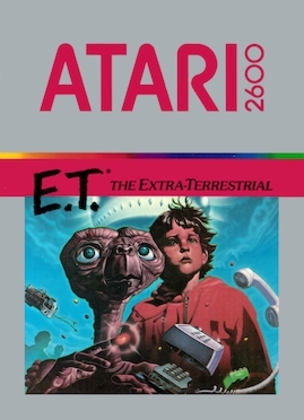
Ask anyone who grew up with a console in the early 80s what happened to Atari and you’ll get the same answer: they buried it. Literally. In September 1983, trucks rolled into a landfill outside Alamogordo, New Mexico, and dumped somewhere around 728,000 game cartridges into a pit, then paved concrete over the top. For thirty years it stayed a campfire story collectors swapped like ghost stories, until a 2014 documentary crew got a permit, grabbed shovels, and pulled real cartridges out of the dirt. E.T. the Extra-Terrestrial was in there. So was Pac-Man. The legend was true.
That landfill is the single best shorthand for what the video game crash of 1983 actually was, and it’s worth understanding if you collect, grade, or just love the NES, because the crash is the reason the NES exists the way it does.
Here’s the setup. Atari’s own E.T. game is the easy villain in this story, and the numbers back that up. Designer Howard Scott Warshaw got the assignment on July 27, 1982, with a deadline of September 1 — just over five weeks to build a game from a movie license Atari paid somewhere between $20 and $25 million to secure. Atari manufactured around 4 million cartridges. Roughly 3.5 million came back unsold or returned. But E.T. didn’t sink the industry by itself. It was the final shove on a shelf that was already collapsing.
The real damage was volume and quality, stacked on top of each other. Atari’s share of the console market fell from 75 percent in 1981 to under 40 percent within a year, as Intellivision, ColecoVision, and a pile of forgettable also-rans crowded the same shelf space. Third-party publishing exploded from three companies to thirty between consecutive Consumer Electronics Shows, and most of them had no idea how to make a good game. Activision co-founder David Crane later said the competition was putting out “the worst games you can imagine.” By the end of 1982 there were over 400 Atari-compatible titles on shelves, and insiders already knew only a tenth of them would ever sell. Meanwhile the Commodore 64 dropped to $199, undercutting dedicated consoles with a machine that also did homework and taxes. Retailers, sitting on $35 games marked down to $5 bins, stopped trusting the category entirely.
The crash numbers are brutal by any measure. The U.S. market went from roughly $3.2 billion in 1982-83 to about $100 million by 1985 — a 97 percent collapse. Companies that seemed untouchable a year earlier just disappeared: Imagic, Games by Apollo, U.S. Games, the works. Atari itself posted $356 million in losses and laid off a third of its staff before Warner sold off the consumer division in 1984.
So when Nintendo brought a redesigned Famicom to North America in 1985 as the Nintendo Entertainment System, it had to solve a trust problem, not a technology problem. The NES shed the words “video game” entirely and called itself an Entertainment System. It shipped with R.O.B., a toy robot built specifically to get the box onto toy store shelves instead of the video game aisle everyone had learned to avoid — a strategy we’ve covered in more detail in our piece on R.O.B. Every cartridge that launched clean carried the gold Nintendo Seal of Quality, a licensing stamp built to do exactly what Atari’s flood of shovelware couldn’t: tell a burned customer this one was checked. We go deeper on how that seal worked, and why it mattered, in our Seal of Quality write-up.
It worked almost too well. By 1988 the industry had rebounded past $2.3 billion annually with Nintendo holding roughly 70 percent of the U.S. market, and by 1989 the whole category topped $5 billion — past its pre-crash peak.
None of that history is why a cartridge is worth grading today, exactly, but it’s why grading exists as a concept at all. The entire reason collectors obsess over seal integrity, box condition, and authenticity on NES carts traces back to an industry that once lost the public’s trust completely and had to earn it back one gold sticker at a time. Next time you’re checking a copy’s condition before sending it in, that landfill in New Mexico is part of the reason the standard is so high. You can browse what a well-preserved piece of that recovery looks like in our gallery of graded games.