

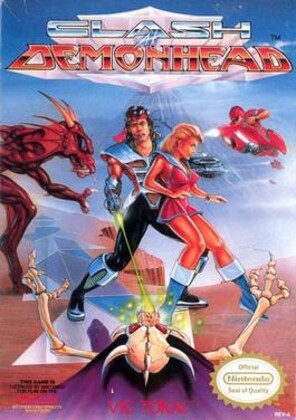
Somewhere in a lot of old NES collections sits a cartridge almost nobody remembers, and yet a piece of it is still floating around pop culture whether people realize it or not. If you’ve seen Scott Pilgrim vs. the World, you already know the name. The fictional rival band that nearly steals the whole movie, Clash at Demonhead, isn’t something Bryan Lee O’Malley invented out of thin air. He lifted it straight off a 1989 Vic Tokai cartridge that most Scott Pilgrim fans have never actually played.
Vic Tokai released Clash at Demonhead in Japan on January 27, 1989, as Dengeki Big Bang!, then brought it to North America that December. It’s an action-adventure platformer that plays like it couldn’t settle on an era. The exploration is years ahead of its 1989 release, closer to the open, go-anywhere structure The Guardian Legend was chasing around the same time. The jumping and shooting underneath it still feels like an early-NES cartridge from a few years earlier.
You play Billy “Big Bang” Blitz, a sergeant with S.A.B.R.E. (Special Assault Brigade for Real Emergencies), yanked off vacation to track down a missing professor and defuse a Doomsday Bomb. The setup gets stranger from there. Six governors hold six medallions. A demon is trying to seize control of people’s minds from inside a mountain. Somewhere in the middle of it all is a weapon called the Sword of Apollo, and a twist ending where the bomb turns out to be alien technology, built by a species that gave up on humanity.
None of that would matter much if the game underneath it were forgettable, but Clash at Demonhead gave players real room to move. A starting handgun and boomerang gun get backed up by collectible Force powers that let Billy shrink, teleport, fly, heal, or go briefly invincible, and the level design branches enough that Vic Tokai claimed over 40 possible routes through the game. For 1989, before “open world” meant anything on a home console, that’s a genuinely ambitious pitch for a cartridge most people skipped at the rental counter.
The North American release also picked up a handful of small, almost funny changes on the way over. Yen prices became dollar signs. Some dialogue got trimmed. The ending credits disappeared entirely. And somewhere in the localization process, a shopkeeper NPC picked up a mustache he didn’t have in Japan — the kind of detail nobody notices until someone points a flashlight at two versions side by side.
A cartridge this overlooked is exactly the kind of thing that makes grading interesting. Clash at Demonhead never sold anywhere close to Nintendo’s big names, which means clean, complete copies don’t turn up nearly as often as the games everyone already knows to look for. If you’re the type who hunts down the games other collectors forgot existed, it’s worth a look through our gallery of graded games to see what condition actually does to a cartridge like this one over three and a half decades.
Scott Pilgrim fans who finally track down an original Clash at Demonhead cartridge tend to have the same reaction: the band name made perfect sense the whole time, they just didn’t know where O’Malley found it. Turns out he found it on a shelf most of us walked right past.