

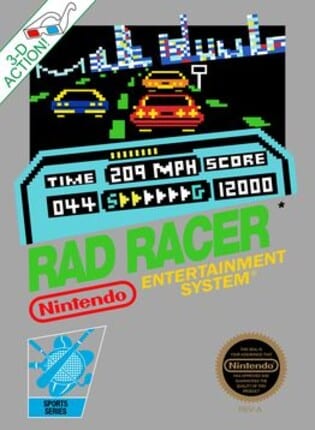
Somewhere in a lot of NES collections from 1987 sits a pair of flimsy red-and-blue cardboard glasses that never got their own game case. They came folded inside the manual for Rad Racer, and putting them on while gunning a Ferrari down a coastal highway is one of the stranger sensory memories of growing up with the console. Press Select, and the flat sprite highway suddenly had depth. It was a cheap trick. It worked anyway.
Square released the game in Japan that August as Highway Star, then brought it to North America that October, published there under Nintendo’s own label. A small team built it, and programmer Nasir Gebelli reportedly hand-drew much of the 3D-mode artwork himself rather than lean on stock assets. Players picked a Ferrari 328 or a generic Formula One car and ran eight stages coast to coast, dodging traffic on a physics engine critics politely called imperfect. Speed was the pitch. Reviewers bought it — Computer and Video Games called it “extremely playable.”
Rad Racer sold close to 1.96 million copies in the U.S., a real hit by 1987 standards. Plenty of retrospective writers couldn’t resist pointing out how closely it resembled Sega’s arcade smash Out Run. Fair enough. It still built its own following: NES-owning kids voted it into the No. 8 spot on Nintendo Power’s Top 30 player poll, and IGN later slotted it at No. 57 on an all-time NES ranking. Not bad for a driving game sold with cardboard eyewear taped into the box.
The game picked up another distinction three years later. Nintendo built Rad Racer into the Nintendo World Championships 1990 cartridge as one of only three games included, alongside Super Mario Bros. and Tetris. Competitors raced its custom timed course for points, with no idea that gray cartridge would eventually become one of the most valuable pieces of plastic in the hobby.
Here’s the part that actually surprised me digging into this one. Despite Rad Racer’s numbers, and a similarly inventive follow-up in 3-D WorldRunner, Square was still in real financial trouble heading toward the end of the decade. The company pulled key staff, including future Final Fantasy director Hironobu Sakaguchi and designer Akitoshi Kawazu, onto Rad Racer during its development, leaving programmer Koichi Ishii to quietly keep building a role-playing game mostly on his own for a stretch. That RPG became Final Fantasy, a title picked because the company genuinely expected it to be its last. Rad Racer didn’t cause that crisis. It just wasn’t enough to stop it from coming.
The game picked up one more footnote a couple years later, showing up on-screen in The Wizard, the same 1989 movie that gave America its first look at the Power Glove. For collectors today, a complete copy of Rad Racer — box, manual, and those two paper-thin lenses folded inside — brings a real premium over a loose cartridge alone, since the glasses are usually the first thing missing from a decades-old copy.
Rad Racer never got the sequel treatment Nintendo gave its bigger 1987 hits, and it’s easy to overlook now next to Square’s later library. But for a few minutes in a lot of living rooms, it made an 8-bit racetrack feel like it had depth nobody expected an NES cartridge to have.