

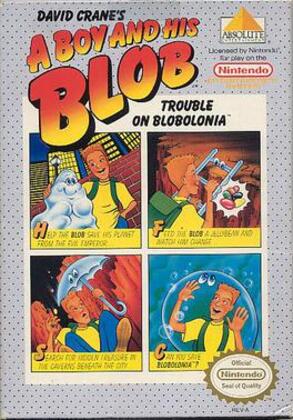
A kid pulls a cartridge out of a Blockbuster case in December 1989 and the box art alone raises questions: a teenage boy standing next to a shapeless pink blob wearing a top hat. No sword. No gun. Just a boy and his blob. That was the entire pitch, and somehow it worked.
A Boy and His Blob: Trouble on Blobolonia came out of Absolute Entertainment, designed by David Crane, the same guy behind Pitfall! and one of the original Activision founders. Crane and Garry Kitchen licensed the concept in the summer of 1989 and had roughly six weeks to finish it, a fraction of the six to eight months NES games usually took. Crane has described working 16 to 20 hour days and going 48 hours without sleep before the final CES presentation. It shows in the game’s rough edges. It doesn’t show in the idea underneath them.
The premise: an alien named Blobert crash-lands on Earth, and the only way to communicate with him is jellybeans. Feed him a licorice bean, he turns into a ladder. An apple bean makes him a lifting platform. A punch-flavored bean turns him into a hole in the ground, a pun on hole punch. Fourteen flavors, fourteen transformations, and you have to memorize every one to get through the game’s underground maze before heading to Blobert’s home planet to fight off an invading emperor. An early build had a grape bean that turned him into a “grape wall,” a Great Wall of China pun Nintendo’s review team flagged as a bug because it separated the player from the blob. Crane swapped it for ketchup, which recalls Blobert to your side instead.
Here’s the part that trips people up: Blobert isn’t controlled by you. He follows you around, reacts on his own, and has to be managed rather than piloted. GamesRadar has pointed to this as one of the earliest recognizable AI companions in a video game, years before escort missions became a genre unto themselves.
Reviews at the time were split down the middle. Electronic Gaming Monthly’s four reviewers landed in the 5-to-6-out-of-10 range, dinging the slow pace and light enemy count. Mean Machines went the other way at 91 percent, calling Blobert’s animation “a masterpiece.” IGN’s later retrospective was blunter, giving it a 4.5 and arguing the idea outran the execution. None of that stopped it from winning Best of Show at the 1989 CES or a 1990 Parents’ Choice Award, and Absolute Entertainment reportedly counted it among the company’s biggest sellers of the era despite the so-so scores.
That gap between critical reception and actual sales is worth sitting with for a second. It’s the same gap that shows up decades later in the secondary market, where a game’s cultural footprint and its price tag don’t always move together. A boxed, complete copy of Trouble on Blobolonia isn’t one of the marquee NES chase titles, which makes it a reasonably approachable way to own a genuinely strange piece of NES design history rather than a five-figure grail. If you’re curious what condition actually does to a cartridge like this, our gallery of graded games has plenty of side-by-sides worth a look.
If the jellybean-as-transformation gimmick sounds familiar, it’s a cousin to the animal-candy mechanic in Little Nemo: The Dream Master, another NES game that built its whole identity around eating something to become something else. Both came out of the same era of designers throwing out the rulebook because nobody had written one yet.
The original NES cartridge got a Wii remake from WayForward in 2009, without Crane’s involvement, plus later ports across PlayStation, Xbox, and Switch. IGN eventually ranked the NES original 74th on its list of the best NES games ever made. Not bad for a game built in six weeks by a designer running on adrenaline and jellybeans, in more ways than one.