

Halloween always arrived early on the NES. Somewhere around the first week of October, a kid who’d normally beg to play Mario Bros. would dig out the one cartridge everyone swore was haunted, turn off every light in the house, and dare a sibling to keep watching. The console never came close to real survival horror. What it had instead was worse in its own small way: cheap jump scares dressed up in grim little sprites, and games that killed you often enough to feel personal. Here are ten that still hold up, counted from merely spooky to the one that actually earned it.
10. A Nightmare on Elm Street (LJN, 1990) — Freddy Krueger shows up mid-level as a disembodied head that drains your energy meter on contact, and the only way to beat him is to track down his scattered bones first, across four interconnected haunted houses. It’s more confusing than frightening. Losing to a floating Freddy face in your own bedroom still got under plenty of ten-year-old skin.
9. Friday the 13th (LJN/Atlus, February 1989) — Jason stalks six camp counselors through an endless swamp and a cabin that never stops catching fire. Nintendo Power later ranked it the sixth-worst game ever made. Neither this one nor Elm Street rated a full spotlight on this blog; both turned up together in our ranking of the NES’s movie and TV tie-ins, two licensed horror games that scared nobody half as much as their box art promised.
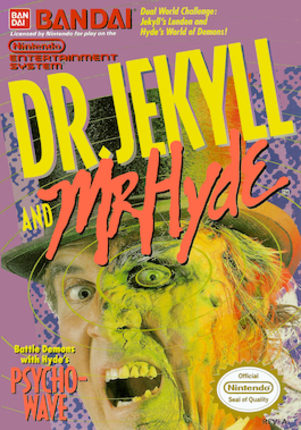
8. Dr. Jekyll and Mr. Hyde (Advance Communication/Bandai, 1988) — Loosely based on Robert Louis Stevenson’s novella, the game splits into two modes: a slow daytime walk as the mild-mannered Jekyll, where bumping into a single pedestrian raises his stress, and a nightmare mode where an enraged Hyde fires “psycho waves” through a mirrored, inverted version of the same street. It’s widely considered one of the most broken games on the system, and its infamy only grew decades later once James Rolfe’s Angry Video Game Nerd series found it.
7. Zombie Nation (Meldac, 1991) — A severed, screaming samurai head floats across a zombie-infested America, leveling mutated monuments along the way. We already gave it a full spotlight on this blog, which should tell you how seriously we take a premise this strange.
6. The Uninvited (ICOM Simulations, developed; Kemco, published 1991) — A point-and-click crawl through a mansion cursed by a corrupt sorcerer’s apprentice named Dracan, where nearly any wrong move turns the player into a zombie before the next room. Same MacVenture engine, same unforgiving trial-and-error logic, as a game ranked higher on this list.
5. Castlevania II: Simon’s Quest (Konami, 1988) — Peaceful villages flip into zombie-swarmed nightmares every time the in-game clock hits night, and half the townspeople lie to your face about how to break Dracula’s curse. Confusing on purpose, and creepier for it.
4. Monster Party (Bandai/Human Entertainment, 1989) — Marketed as a goofy kids’ romp, it hides a shockingly grim mid-game transformation sequence that slipped real gore past Nintendo’s content standards by dressing it up as monster-movie parody. We covered the full story in our dedicated Monster Party spotlight.
3. Castlevania III: Dracula’s Curse (Konami, 1990) — Branching paths, a playable Grim Reaper boss fight, and some of the darkest, most atmospheric stage design the NES ever produced for a game this polished.
2. Shadowgate (Kemco/ICOM, December 1989) — A wizard’s tower that kills you in dozens of inventive, often absurd ways, with zero warning and zero mercy. We broke down exactly how brutal in our Shadowgate spotlight.
1. Castlevania (Konami, 1987 North American release) — Still the template. Vampire hunter Simon Belmont whips his way through a gothic castle stocked with Frankenstein’s monster, mummies, bats, and Dracula himself, scored by music that still turns up on Halloween playlists decades later. Read the full history in our original Castlevania spotlight.
None of these sold like Mario, and horror licenses in particular tended to ship in smaller print runs before getting beaten up at the rental counter for a weekend. That’s part of why a genuinely clean, high-grade copy of something like the original Castlevania, or an oddity like Dr. Jekyll and Mr. Hyde, can be harder to track down in top condition than the quality of the game alone would suggest.