

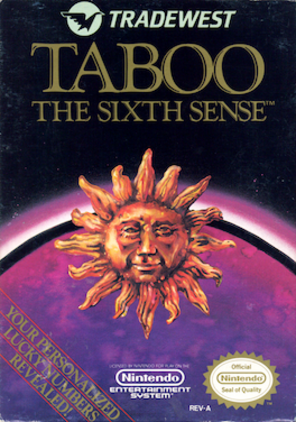
Picture flipping past Duck Hunt and Mega Man 2 on a toy store shelf in 1989 and landing on a cartridge that tells your fortune. That’s Taboo: The Sixth Sense, and it may be the strangest thing Nintendo ever let onto store shelves.
Rare made it. Yes, that Rare — the same studio that would spend the next decade cranking out Donkey Kong Country and GoldenEye 007. In 1989 they were still a scrappy UK developer taking any contract that paid, and publisher Tradewest handed them an odd one: build a tarot card reading simulator for the NES. David Wise, the composer who would later score the entire Donkey Kong Country trilogy, wrote the music. Julian Jameson designed it. Nobody at Rare has ever explained how this got greenlit.
Here’s the pitch, such as it is. You type in your name, your birthday, and your gender, then ask the cartridge a question. It shuffles a full 78-card deck — all 22 Major Arcana, all 56 Minor Arcana — lays the cards out in a Celtic cross, and reads your fortune back in vaguely ominous sentences. One real line from the game: “presently influencing you is reliable, kind, generous, and learned.” Make of that what you will. If fortune-telling isn’t doing it for you, there’s a lottery number generator tucked in too, keyed to whichever U.S. state you pick. There is no winning or losing. There’s just the reading.
Taboo also holds a distinction no other NES cartridge can claim: two separate warning labels on the box, one for ages 14 and up, one stating the whole thing is for entertainment purposes only. The cards include nudity and overtly religious imagery — the High Priestess, the Lovers, the Devil — exactly the kind of content Nintendo of America’s famously strict approval process was built to reject. How this specific cartridge slid through remains one of the NES library’s genuine mysteries.
It picked up a reputation it probably didn’t earn. An urban legend has circulated for years claiming the game accurately predicted the deaths of a few kids who played it. There’s no documentation behind that story anywhere — it’s internet campfire talk, not history — but it has stuck to Taboo the way ghost stories stick to abandoned houses. A 2008 review on HonestGamers gave it half a star out of five and called it a cursed curiosity, which is about as kind as contemporary coverage ever got.
None of that stopped it from becoming a minor collector curiosity decades later. A loose cartridge runs around $9 today, a complete-in-box copy closer to $40, and a factory-sealed copy around $77, with WATA- and CGC-graded examples turning up from specialty sellers for considerably more. It’s proof that an NES game doesn’t need to be good, or even really be a game, to end up on a collector’s shelf next to Cheetahmen II and Stadium Events in the library’s permanent cabinet of oddities.
If Taboo is the strangest thing Nintendo ever allowed through, it has company. Our look back at Cheetahmen II covers another cartridge nobody should have been able to sell, and the Stadium Events story traces a different game Nintendo actively tried to erase. For a sense of how graders sort the genuinely sealed from the merely weird, our gallery of graded video games is a good place to start.