

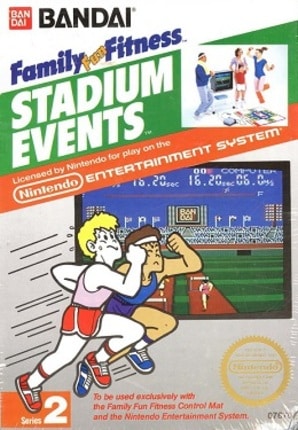
Picture finding a shrink-wrapped NES cartridge at an estate sale, boxed up next to a stack of Trivial Pursuit games nobody wanted. It looks like nothing special — a track-and-field game with a guy mid-hurdle on the cover. Then someone tells you it just sold for $41,977. That cartridge is Stadium Events, and the reason it’s worth more than most used cars has nothing to do with the game itself.
Human Entertainment built Stadium Events for Bandai’s Family Fun Fitness line, a floor-mat controller meant to get kids moving through four Olympic-style events: the 100-meter dash, the long jump, the hurdles, and the triathlon. Japan got it in December 1986. North America followed in September 1987, bundled with the mat for a price well above a normal cartridge.
It didn’t last. Nintendo bought the rights to the mat technology behind Family Fun Fitness and relaunched the whole package under its own name: the Power Pad. The game got a new label too — World Class Track Meet, same cartridge, same four events, Nintendo’s logo instead of Bandai’s. By June 1988, Bandai’s version was gone from shelves entirely, less than a year after it showed up.
That short window is the whole story. Nobody knows exactly how many copies of Stadium Events reached stores before the switch, but it wasn’t many by NES standards, where even a flop usually printed tens of thousands. A popular legend claims it sold at exactly one Woolworth’s location and nowhere else. Collectors have picked that story apart over the years — it moved through more stores than that, just briefly and quietly. Former Nintendo employee Howard Phillips has also pushed back on theories that leftover stock was pulled and destroyed, pointing out that reworking every unsold cartridge would have been impractical for a company Nintendo’s size.
Whatever actually happened on the distribution side, the result is the same: a game that looks like any other budget sports cartridge from 1987 became the NES holy grail. A factory-sealed copy sold for $35,100 in one widely reported sale, and another changed hands privately for $41,977 after a botched eBay auction fell through and a buyer stepped in directly. Loose copies with the box and manual still intact routinely command four and five figures — territory usually reserved for the rarest Black Box titles.
That kind of money attracts forgeries, which is exactly why third-party grading exists for a game like this. A reseal job or a swapped label can turn a $2,000 loose cartridge into a fake “sealed” one worth thirty times as much, if nobody checks the seam pattern, the shrink-wrap texture, or what’s actually inside the box — the same con detailed in our look at how graders catch a fake shrink-wrap job. Stadium Events has landed on more than one rarest-NES-cartridge ranking for exactly this reason, and a graded, authenticated copy is one of the few purchases in this hobby where the paperwork is worth almost as much as the plastic. Our own gallery of graded cartridges gives a sense of what that authentication actually looks like up close.
The strange part is that World Class Track Meet, the version Nintendo kept selling, ran on identical code — same mat, same four events. Nintendo didn’t erase a bad game. It erased a name, and collectors spent the next three decades deciding that name alone was worth six figures.