

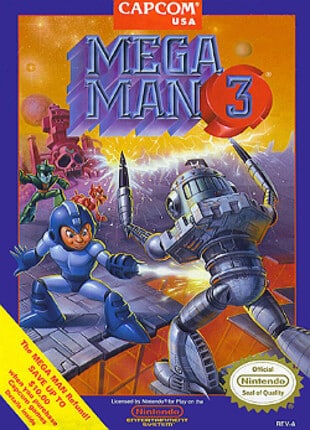
You beat Mega Man 2. You felt unstoppable. Then you popped Mega Man 3 into the console expecting more of the same triumphant blue-bomber action, and the game handed you a slide button, a robot dog with three separate personalities, and a mystery rival in dark armor who showed up just to knock you off a cliff and vanish. That was November 1990. Capcom wasn’t interested in giving anyone a comfortable sequel.
Mega Man had already proven itself, and Mega Man 2 turned the series into a genuine hit. Mega Man 3 launched in Japan on September 28, 1990, with a North American release following later that fall, developed and published by Capcom for the NES. The polish is all over the final product. The process behind it was a different story.
Series director Keiji Inafune has said Mega Man 3 sits near the bottom of his own list of favorites in the original run, and it’s easy to see why once you know what happened. The staffer who’d been handling lead planning duties left partway through development, and Inafune got stuck absorbing that role on top of his own. He’s described the final two months as particularly turbulent. Capcom also moved the launch window earlier than the series’ usual December slot, pushing the team to ship before everyone felt the game was actually finished. Composer Harumi Fujita left mid-project after giving birth, and Yasuaki Fujita came in to finish the soundtrack she’d started.
None of that chaos kept the game from introducing ideas that stuck around for decades. The slide move, Mega Man’s first, let players duck under fire and squeeze through gaps that used to be dead ends. Rush the robot dog showed up as a real companion for the first time, switching between a spring-loaded Coil form, a Jet form for flight, and a Marine form for underwater stages. Proto Man, Dr. Light’s earlier and more mysterious creation, got his first appearance here, whistling his theme and testing Mega Man’s resolve before disappearing into the credits of half the game’s cutscenes. And because the team needed to pad out a rushed schedule, they built the Doc Robot stages, which recycle four Robot Masters from Mega Man 2 wearing new paint and attitude.
Reviewers noticed the ambition even if they complained about the difficulty. Electronic Gaming Monthly handed it consistent 9-out-of-10 scores across its review team, and GameSpot later called it Capcom’s high point on the NES. GamePro’s writers joked that finishing the game was harder than pulling teeth or lifting a car over your head. Commercially it sold around 1.08 million copies worldwide, a solid number for a fall 1990 NES release competing against a console entering the back half of its life. Capcom also received something like 50,000 Robot Master design submissions from fans for this entry and used only eight of them, which tells you plenty about how much goodwill the series had already built by its third outing.
If you’re chasing a graded copy today, condition on Mega Man 3 gets tricky fast. The cartridge label uses a lot of dark background color that shows scuffs and edge wear more obviously than lighter NES labels do, and complete-in-box copies from this stretch of Capcom’s catalog don’t turn up nearly as often as first-party Nintendo titles. Worth a look in our gallery of graded games if you want to see what a well-preserved copy actually looks like next to a beat-up rental shelf survivor. And if you want the full argument over whether this one or its predecessor deserves the crown, we already settled that fight in Mega Man 2 vs. Mega Man 3.
Thirty-five years later, the rushed corners barely show. The slide still feels good. Rush still feels like a real sidekick instead of a gimmick. And Proto Man’s whistle still means something’s about to go wrong.