

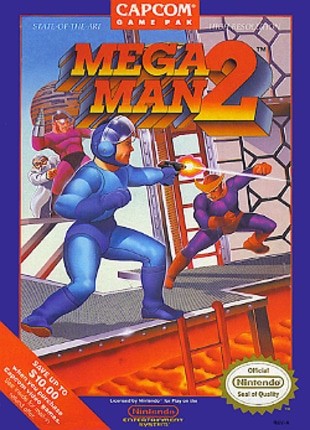
Ask two NES collectors which Mega Man game is the real classic and you’ll get two different answers, both delivered like they’re obvious. One camp points at Mega Man 2 — the one with the password screen everyone still hums, the one your cousin had, the one that shows up on every “greatest games ever” list. The other camp waves that off and brings up Mega Man 3, the game that actually taught the series how to move. Rush. The slide. A rival in a red scarf nobody asked for and everyone remembers. Both sides think the argument is settled. It isn’t.
Mega Man 2 came out in North America in June 1989, built in roughly three to four months by a team pulling twenty-hour days on their own time between other Capcom assignments. Keiji Inafune later called it the best stretch of his career at the company — everyone rowing the same direction for once. Capcom ran a public contest for Robot Master designs and got 8,370 submissions; the eight bosses that made the cut, Metal Man through Wood Man, were tweaked fan ideas. The gamble paid off. All four Electronic Gaming Monthly reviewers gave it an 8 out of 10, and it went on to sell more than 1.51 million copies worldwide, a number that stood as the series’ second-best until Mega Man 11 passed it in 2019.
Mega Man 3 arrived in North America that November, roughly a year and a half later, and by Inafune’s own account it shouldn’t have shipped when it did. The lead supervisor left partway through development, the main planner was gone too, and Inafune found himself covering both jobs on a game Capcom pushed out ahead of its usual December window. You wouldn’t guess any of that from playing it. Mega Man 3 is where the slide move shows up for the first time, where Rush replaces the old item-drop system with a dog that turns into a raft or a jetpack, and where Proto Man walks in mid-level, whistles, and disappears — a rival nobody had set up and everybody talks about. EGM liked it even more than the previous entry, handing it a 9 out of 10, though GamePro cracked that beating it was harder than “pulling teeth” or “performing open-heart surgery.” Reviewers agreed it looked and sounded better than anything Capcom had put on the NES — they just didn’t always agree you’d survive it.
So which one actually wins? By the numbers at the time, Mega Man 3 was the better-reviewed game. By the numbers since, Mega Man 2 is the better-selling one, and it’s not close — 1.51 million against roughly 1.08 million. Part of that gap is just math: Mega Man 2 had more years on store shelves before the NES market thinned out, and it got the benefit of being first to prove the sequel formula worked at all. Mega Man 3 had to build its reputation on word of mouth after the fact, which is a slower way to sell cartridges but not a bad way to build a legacy. Ask a collector today which cartridge they’d rather find complete in box, and you’ll hear plenty of votes for 3 — it’s the one that actually plays like the series everyone remembers, gun-toting box art aside.
That split between sales and reputation shows up in the grading market too. High-grade sealed copies of Mega Man 3 have started closing in on Mega Man 2 prices at auction, even with the smaller print run behind it, because collectors chasing a complete series run treat both as must-haves rather than picking a favorite. If you want to see what that kind of grading premium actually looks like across NES titles, the gallery of graded games is worth a scroll.
Maybe that’s the honest answer. Mega Man 2 opened the door. Mega Man 3 is what walked through it.