

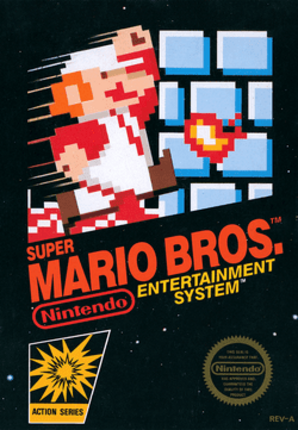
Somewhere in a rec room in 1985, a kid feeds a gray cartridge into a top-loading NES, flips the power switch, and waits through a half-second of static before that blue sky and green pipe fill the screen. World 1-1. Nobody in that room knew they were about to memorize sixty seconds of level design so completely that they could still walk through it blind decades later.
Super Mario Bros. hit Japanese shelves on September 13, 1985, arriving in North America that October as the pack-in game bundled with the NES itself. Nintendo R&D4 built it under director and producer Shigeru Miyamoto, with Takashi Tezuka handling level design and Toshihiko Nakago writing the code. Composer Koji Kondo was in the room from day one, an unusual arrangement for 1985 — most games got their music tacked on at the end by whoever was free. Kondo tuned his tempos to match how fast Mario actually moved on screen, which is part of why the underground theme still feels like it’s chasing you.
The game had to fit into 256 kilobits of program code and 64 kilobits of graphics, numbers that sound almost fictional next to a modern game’s install size. The team recycled sprites wherever they could get away with it. The clouds and the bushes are the same shape, just recolored, because nobody was going to notice at 60 frames a second. By the time the soundtrack was locked in, the cartridge had roughly 20 bytes of space left. Miyamoto used it to draw the little crown that shows up next to your life counter once you rack up enough extra men. Twenty bytes, one crown, and the budget was gone.
World 1-1 gets studied in game design courses now, and not by accident. The level teaches you to run, to jump, to break blocks, and to fear Goombas, all without a single line of instructional text — the placement of that first enemy and that first pipe does the job instead. It’s widely considered one of the most carefully engineered tutorials ever shipped, and Nintendo never called it a tutorial at all.
Push the cartridge the wrong way and the game teaches you something else entirely. The Minus World is an unwinnable underwater loop hiding at World 36-1, reachable through a wall-clipping glitch that most ten-year-olds found by accident and passed along by word of mouth. The game’s underlying code turns out to contain well over 200 similar glitch levels that were never meant to be seen, let alone played.
None of that would matter much if the game hadn’t sold. The NES version alone moved more than 40 million copies by 1994, and counting every port and re-release, the total climbs past 58 million — enough to hold the Guinness World Record for best-selling video game until Wii Sports finally passed it decades later. By 1990, surveys found American kids recognized Mario’s face more readily than Mickey Mouse’s. Alongside the NES itself, this cartridge gets a lot of the credit for pulling the U.S. game industry back from the wreckage of the 1983 crash.
It’s also, these days, a genuinely valuable thing to own in the right condition. One sealed, unopened copy sold for $3 million at auction, the kind of number that turns a childhood pack-in game into a museum piece. If you’re curious what separates a cartridge like that from the loose copy gathering dust in a closet, our gallery of graded games is a good place to start looking. And if you want the deeper dive on why a 41-year-old game still shows up on best-of-all-time lists, the record speaks for itself: it didn’t just launch a franchise, it kept a console — and an entire industry — alive.