

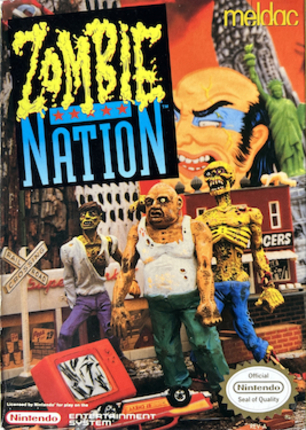
Every kid who grew up renting NES games remembers scanning the rental shelf for something the neighborhood hadn’t already beaten. Tucked between recognizable names, one box always stopped people cold: a giant floating samurai head, snarling over a burning American skyline. That was Zombie Nation. Nothing about the cartridge inside made the box art make any more sense, and three decades later, that’s still basically the whole pitch.
Zombie Nation was developed by KAZe and published by Meldac. It reached Japan in December 1990 under the title Abarenbou Tengu, then crossed to North America a month later in January 1991. It’s a side-scrolling shoot ’em up: four selectable stages plus a final boss, built around a mechanic almost nothing else on the console tried. You don’t fly a ship or walk a character across the ground. You control a severed head, floating freely around the screen, firing rapid bursts of eyeballs and something best described as projectile vomit at everything in your path.
The head itself tells you everything about how differently this game landed in each market. In Japan, players flew a tengu mask, a long-nosed demon straight out of local folklore. American publishers gambled that a floating demon mask wouldn’t register with U.S. kids the way a floating samurai head would, so Namakubi was born, and the plot got rewritten to match: travel to America, rescue zombie hostages from a villain named Darc Seed, and reclaim a stolen sword called Shura. Even the Statue of Liberty boss got redesigned, gaining a head of snakes it never had in the original Japanese release.
Critics genuinely could not agree on what to make of it. Nintendo Power landed at a lukewarm 3.15 out of 5. GamePro liked it a lot more, scoring it 4.6 out of 5. Dragon magazine wasn’t impressed at 2.5 out of 5. Somehow, the St. Petersburg Times still ranked it among 1992’s ten best games, a claim that hasn’t aged into consensus so much as into legend. Decades later, Mashable called Zombie Nation the second-weirdest video game ever made, and that might be underselling it.
Longtime collectors love pointing out one detail. The classic Konami code, up up down down left right left right B A, works in Zombie Nation. Punch it in during a continue and your life bar refills instantly, a cheat borrowed from a completely unrelated publisher and quietly built into a game about a flying, screaming head. Contra made that code famous. Zombie Nation just helped itself to it.
It wasn’t the only NES cartridge willing to get genuinely strange while Nintendo’s approval process looked the other way. Monster Party pulled a similar trick a few years later with blood Nintendo’s guidelines were supposed to keep out. Neither game sold well enough to matter much at the time.
That low original print run is exactly why Zombie Nation matters to collectors now. It never moved serious volume off store shelves, which means far fewer cartridges survived than for a mainstream release from the same year. Loose copies routinely sell in the $400 to $500 range today, complete-in-box examples push past $1,000, and a sealed copy is rare enough that one selling at all becomes news among collectors. Obscurity turned into scarcity, and scarcity is the whole engine behind the graded games we showcase here — the titles nobody wanted in 1991 are often the ones worth grading carefully in 2026.
Zombie Nation never got a sequel, a reissue, or much respect. It got something better: decades of people still trying to explain exactly what they were looking at.