

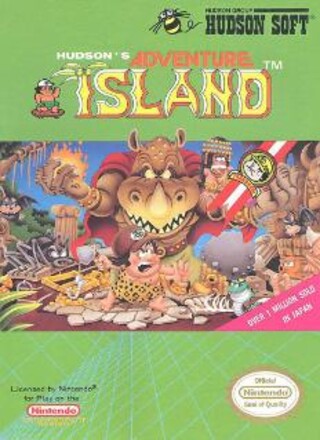
You rent Adventure Island from the video store on a Friday, blow through the first stage in under a minute, and die on the second one because you forgot to eat. That’s the whole game in a nutshell. Master Higgins doesn’t just run and jump. He’s constantly starving, and the clock on that hunger bar never stops.
The game exists because of a licensing wall. In 1986, Sega’s arcade cabinet Wonder Boy, developed by a small studio called Escape, was a hit. Hudson Soft wanted to bring it home to the Famicom, and it got the rights to adapt the game itself. What it didn’t get was the Wonder Boy name or Sega’s blessing to keep the original hero once the deal moved to Nintendo’s hardware. So Hudson built its own guy from scratch and named him after Toshiyuki Takahashi, a real Hudson Soft employee who’d already made himself famous by mashing a joystick button 16 times a second on television. Master Higgins made his Japanese debut that September as Takahashi Meijin no Bōken Jima. North America didn’t see him until September 1, 1988, nearly two full years later, when NES owners finally got Adventure Island off the shelf.
Underneath the reskin, the mechanics changed too. Higgins works his way through thirty-two stages spread across eight worlds, armed with a stone axe that upgrades into fireballs if you find the right item along the way. Pick up a skateboard and he moves much faster, and much less controllably. The plot is simple: his girlfriend Tina has been snatched by an Evil Witch Doctor, and getting her back means fighting that same boss eight times, in eight different disguises. None of it would be especially hard if not for the hunger meter, draining constantly, forcing you to scoop up fruit just to survive long enough to reach the next checkpoint.
That combination made Adventure Island one of the meaner platformers in the NES library, with a reputation that puts it in the same conversation as Ghosts ‘n Goblins for sheer unforgiving design. Reviews at the time split down the middle. Some critics liked the challenge and the soundtrack’s genuine bounce. Others wrote it off as a slippery, repetitive Mario clone that punished you for controls it never fully explained. Time has been kinder to it than the initial notices were. GamesRadar later placed it among its top 25 NES games of all time, and it’s still commonly cited as one of the toughest third-party platformers the console ever hosted.
The reskin trick worked well enough to outlive the licensing dispute that created it. Adventure Island spun off into its own long-running series across the Game Boy, the TurboGrafx-16, and well beyond, running in parallel to Sega’s original Wonder Boy games for years without much overlap between the two fanbases. Konami owns the whole family tree now, having absorbed Hudson Soft in 2012.
None of that makes a loose Adventure Island cartridge rare. Hudson printed plenty of them, and it’s an easy find in any box of old NES games at a flea market. What holds up is the box art: a cartoonish Master Higgins mid-leap, bright enough to still pop on a shelf next to games three times its age. A clean, complete-in-box copy with an intact manual is worth tracking down if you’re building out a collection, and it’s exactly the kind of thing worth running past a grader before you decide what it’s actually worth. Our gallery of graded games is a good place to see what separates a shelf-worn survivor from something genuinely presentable.