

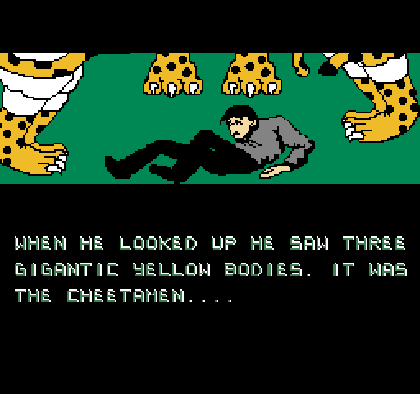
When he looked up, he saw three gigantic yellow bodies looming over him. That is the actual opening line of Cheetahmen II, and somehow it’s the most normal thing about the whole game.
Cheetahmen II never had a real release. It was built by Active Enterprises, the Miami outfit behind Action 52, the infamous 52-in-one NES multicart from 1991 that crammed dozens of half-finished games onto one board and sold the whole mess as a value pack. Cheetahmen, designed by Mario Gonzalez, was game number 52 on that cart, and company owner Vince Perri had bigger plans for it. He wanted a media franchise to rival the Teenage Mutant Ninja Turtles, complete with a Saturday morning cartoon and a full toy line. Almost none of it happened. A standalone sequel almost didn’t either.
Cheetahmen II shipped with only six of ten planned levels finished, and Active Enterprises never got it into stores. But the cartridges existed. Workers built somewhere around a thousand to fifteen hundred of them by reusing leftover Action 52 shells and circuit boards, sticking a small gold label reading “Cheetahmen II” over the old one, then shrink-wrapping the boxes like they were headed for a shelf. They weren’t. The whole stock sat forgotten in a warehouse for years.
Around 1996, a collector named Mike Etler bought out the entire find for next to nothing, reportedly under ten dollars a cartridge. Word spread once retro collecting moved online in the early 2000s, and a cheap warehouse dump turned into one of the most chased oddities in the hobby. Shrink-wrapped copies now sell for hundreds on the open market, and top-graded sealed examples have crossed the block at major auction houses for sums that would have stunned Etler back in 1997.
Here’s what makes it a genuine oddity instead of just a rarity: the game itself isn’t good. It carries the same broken hit detection and stiff controls that made Action 52 a punchline among anyone who actually plugged it in. Nobody is hunting down Cheetahmen II because it plays well. They’re hunting it because almost nobody was supposed to own one, and the cartridge tells a stranger story than anything happening on screen.
That backstory raises a real question for anyone grading vintage cartridges, too. If the legitimate release was already a relabeled Action 52 board with a sticker slapped on top, telling a genuine Cheetahmen II from a convincing fake built the same way decades later takes real scrutiny, not a glance at a box. It’s the same puzzle we’ve walked through with reproduction cartridges more broadly, and it’s exactly the kind of case that separates careful authentication from a guess.
Cheetahmen II isn’t alone in this corner of NES history, either. Stadium Events pulled off a similar trick, turning a failed release into a six-figure legend decades later. Both cases prove the same point: on this console, the story behind a cartridge can end up worth more than what’s actually loaded on it. If you’re curious what real authentication looks like on a case this strange, our gallery of graded games is worth a look, and Wikipedia’s rundown of Action 52 fills in the rest of the mess Active Enterprises left behind.