

Two controllers, one console, and a screen that filled with bullets faster than either of you could track. That was Life Force on a good Saturday afternoon. One player took point, the other covered the flanks, and neither of you fully understood the plot. Nobody needed to. You just needed a friend who wouldn’t hog the power-ups.
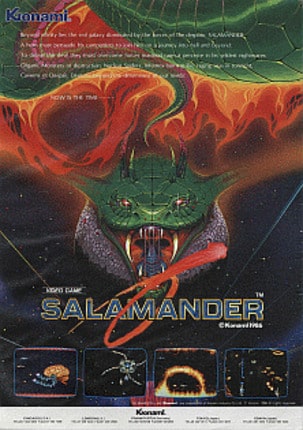
Konami built Life Force as the North American arcade version of Salamander, a 1986 spin-off of its own Gradius series. Nintendo brought it home for the NES in August 1988, and the port kept the two-player simultaneous co-op that made the arcade cabinet worth the extra quarter. That alone set it apart from most shooters on the console, where a second player usually meant taking turns, not sharing the screen. The NES version also borrowed the selectable power-up bar from Gradius rather than the capsule pickups the original arcade cabinet used, a small mechanical swap that longtime shooter fans noticed immediately.
Here’s the part most players never clocked: the western release quietly swapped the entire premise. Japan’s Salamander stuck with straightforward space-war sci-fi. The American arcade version reworked the story so your ship was flying through the inside of a massive living organism, and the enemies you were shredding were bacteria and tumors rather than robots and alien war machines. Backgrounds that once looked like circuitry got redrawn as veins and tissue. It’s a strange choice for a family console in 1988, dressing up interstellar combat as microscopic surgery, but it gave the game a visual identity nothing else on the NES shared.
Not every enemy got the full makeover. One of the arcade version’s boss redesigns, a dragon called Intruder, didn’t get reworked into anything biological at all. Someone on the art team just recolored it blue and moved on. It’s a small detail, but it’s the kind of shortcut that tells you how a real deadline actually worked in 1986, long before anyone assumed a boss fight needed a backstory.
The NES port also carried over Konami’s own cheat code, the same 30-lives trick that made Contra a household name among kids who’d never admit to needing it. Life Force supported the full sequence, and with a shooter this unforgiving, most households used it without shame. Electronic Gaming Monthly later ranked the game 76th on its list of the best console games ever made, calling it one of the coolest shooters of its era. That’s a real compliment from a magazine that saw everything the genre produced through the nineties.
We put Life Force on our list of the ten best Konami games on the NES without ever giving it a spotlight of its own, which felt like an oversight worth fixing. It sits in an odd spot in Konami’s catalog: a spin-off of a spin-off, released here under a different name than half the world knew it by, built on the bones of Gradius but distinct enough to earn its own following.
For collectors, complete copies hold up reasonably well against other Konami shooters from the era, and cartridge label condition tends to be the detail that separates a strong grade from an average one. Two-player games got handled roughly, passed between hands and left in consoles for marathon sessions, so label scuffing and corner wear show up more often here than on games that mostly saw solo play. The box art rarely survived intact on rental copies either, so a matched box and manual bumps a copy’s value noticeably above a loose cartridge. If you’re curious what separates a mint-condition cartridge from a well-loved one, our gallery of graded games is worth a browse before you go hunting at your next flea market.
Life Force never got the cultural footprint of Konami’s bigger names. It didn’t need one. It had a friend, a second controller, and a screen full of things worth shooting.